
Introduction
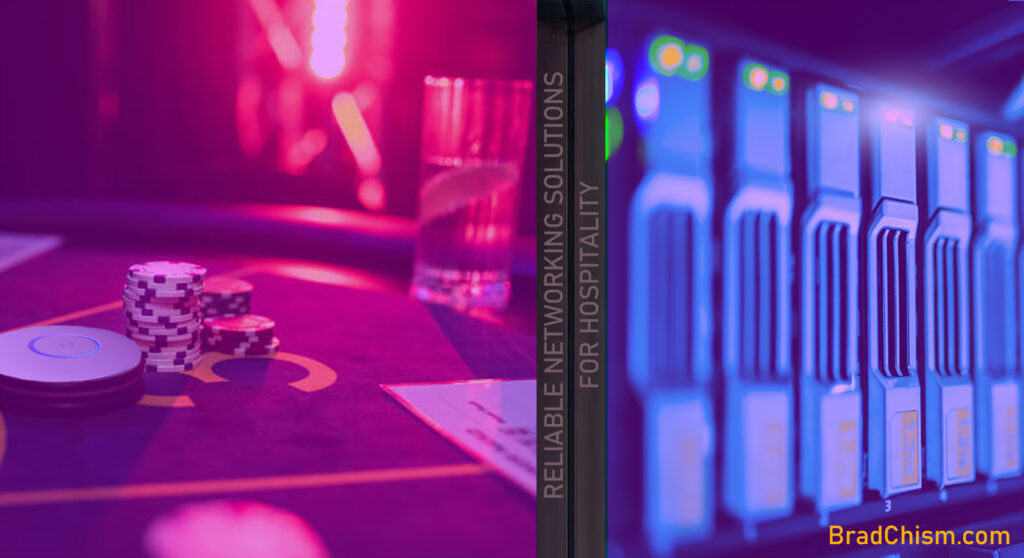
Clark County’s hospitality industry centers on Las Vegas, the global epicenter (epiccentre for those across the ocean) for gaming, conventions, and entertainment. From the massive resorts on the Strip to Henderson’s premium communities, Boulder City’s historic lodgings, and Mesquite’s golf properties, connectivity and fluidity drives the guest experience. In this hyper-competitive market, your networking infrastructure can make or break your businesses reputation.
Common Networking Challenges in Clark County Hospitality
⚡ Extreme RF Congestion
The Las Vegas Strip features the highest density of radios, access points, and devices of almost any city. Thousands of rooms for guests and employees packed into single properties create unprecedented wireless interference and spectrum exhaustion.
🏢 Massive Convention Center Loads
Mega-events at the Las Vegas Convention Center such as Defcon and resort exhibition halls flood networks with hundreds of thousands of simultaneous device connections. They also can create security holes most beings don’t think about. Standard hospitality networks crash under these sudden, massive data spikes.
🎰 Casino Floor Security Requirements
Nevada gaming regulations mandate strict, physical, and logical network separation. Something that all places should take in consideration. Casino operational data, player tracking systems, guest services, and public Wi-Fi cannot share pathways nor should they be considered open for invites from security engineers.
☀️ Desert Heat and Power Instability
Summer temperatures in Vegas regularly exceed 100°F with a known high of 120°F in 2024 indicating Vegas may be becoming hotter and should have an immediate focus on how it’s going to progress, this heat places immense strain on data cooling systems. Simultaneous city-wide power demands cause voltage sags and grid instability that threaten network uptime which is why you need someone who understands this and can keep your operations up when the demand is the greatest.
County-Specific Requirements
To dominate the Clark County market, hospitality networks must meet four uncompromising pillars:
- Flawless Streaming: Guests demand zero-latency for their 4K & 8K streaming, mobile gaming, and secure corporate VPN connectivity.
- Zero-Downtime Architecture: Vegas doesn’t seem to rest, eliminating traditional late-night maintenance windows. Systems must feature hot-swappable components.
- IoT Smart Room Integration: Networks must seamlessly support Smart lighting, Voice Assistance, Window Treatments, digital keys, and networked thermostats.
- Strict Regulatory Compliance: Infrastructure must fully align with the Nevada Gaming Commission’s rigorous cyber security and data isolation standards.
Enterprise-Grade Networking Solutions
🚀 Wi-Fi 6E & Wi-Fi 7 High-Density Deployments
Upgrading to 6GHz wireless band bypasses legacy 2.4GHz and 5GHz congestion. This unlocks ultra-wide channels for a clean spectrum, allowing every access point that is part of the business guest environment to support thousands of devices without performance degradation or possible interference from other bands.
📶 Enterprise DAS & Private 5G Networks
Tier-1 & Tier-2 resorts should deploy Distributed Antenna Systems (DAS) to eliminate cellular dead zones in deep concrete basements. Forward-thinking properties using the proper network engineer should use Private 5G bands to isolate internal hotel operations from public network traffic.
🌐 Redundant WAN Connectivity
Mission-critical properties should protect revenue with using multi-carrier fiber or internet services, line-of-sight backups, and automated low-latency cellular failovers.
🔒 Casino-Grade Network Segmentation
Utilizing Next-Generation Firewalls (NGFW) and Zero-Trust Network Access (ZTNA) ensures absolute isolation of networks that need to stay protected, such as Gaming networks and operations networks. This setup guarantees compliance while maintaining maximum bandwidth to allocate for your public guest Wi-Fi that should be isolated from your business.
❄️ Industrial Environmental Controls
Deploying dedicated, Precision Cooling units on a closed network keeps network rooms safe from desert heat. These systems pair with double-conversion online Uninterruptible Power Supplies (UPS) to clean up dirty grid power.
[Public Guest Wi-Fi] ───┐
[IoT Smart Rooms] ───┼───► [Zero-Trust Segmentation] ───► [Triple-Redundant WAN]
[Casino Operations] ───┘
Local Implementation Factors
Success in Clark County requires strategic coordination with local entities:
LVCVA Resources: Leverage tech guidelines from the Las Vegas Convention and Visitors Authority.
- NV Energy Partnerships: Coordinate with NV Energy to deploy commercial-grade surge suppression and automated demand-response battery backups.
- Compliance Alignment: Work with certified Nevada Gaming Commission technology auditors during the initial design phase to prevent costly retrofits.
Conclusion
Clark County’s hospitality market demands the most robust networking infrastructure on earth. By deploying high-density wireless, zero-trust security, and hardened environmental controls, properties can eliminate downtime, secure their operations, and deliver the world-class digital experiences today’s guests not just expect but demands.
Frequently Asked Questions (FAQs)
Why is Wi-Fi 6E/7 essential for Las Vegas Strip hotels?
Legacy 2.4GHz and 5GHz wireless bands are entirely oversaturated on and around the Las Vegas Strip due to the extreme density of resort access points. Wi-Fi 6E and Wi-Fi 7 introduce a cleaner band which is a 6GHz spectrum, providing the interference-free channels necessary to support thousands of streaming devices simultaneously.
How do Nevada gaming regulations impact hotel Wi-Fi design?
The Nevada Gaming Commission requires absolute isolation of the gaming infrastructure from public networks. Resorts must use advanced network segmentation, separate physical switches, and zero-trust security architectures to ensure guest Wi-Fi traffic can never interact with casino floor operations.
What is a Distributed Antenna System (DAS) and does your business need it?
A DAS is a network of spatially separated antennas that boosts cellular signals inside large buildings. Because Clark County has mega-resorts that are constructed with heavy concrete, steel, and low-E glass, a DAS with properly placed antennas is critical to eliminate indoor cellular dead zones on casino floors and within a convention environment.
How do hospitality networks handle massive convention crowds?
High-density convention spaces utilize specialized access points with extended antennas and proper load balancing. This infrastructure dynamically shifts bandwidth based on crowd movement, preventing individual access points from becoming overwhelmed during keynotes and exhibitions.
How does the Clark County climate affect network hardware?
Extreme summer heat sometimes exceeding 110°F can cause rapid hardware failure in unconditioned spaces. Hospitality networks in the region require hardened network rooms equipped with independent, redundant HVAC systems and real-time environmental monitoring sensors.
What happens to hotel networks during an NV Energy grid fluctuation?
Luxury resorts utilize double-conversion UPS systems that constantly condition incoming power, neutralizing voltage sags and surges. In the event of a total blackout, these systems can sustain the network seamlessly until the emergency diesel generators start up.